3. Running ensembles
An ensemble is a set of independent trajectories of one model, called replicates. This chapter runs ensembles, makes them reproducible, and shows how a run can end. The setup block builds the immigration–death model of chapter 2. The blocks of this chapter continue from it:
import numpy as np
import crn_craft as crn

model = crn.Model("immigration_death")
model.add_parameter({"birth": 4.0, "death": 0.2})
model.add_species("A", 0)
model.add_reaction("birth", [], ["A"], name="birth")
model.add_reaction("death * A", ["A"], [], name="death")
Many trajectories in one call
One call runs any number of independent trajectories on native threads and
returns their statistics. There is no loop to write and no result to collect
by hand. crn.ensemble builds a run request, checks it and prepares it.
simulate() then runs the replicates:
run = crn.ensemble(
    model, end=30.0, report_times=list(np.linspace(0, 30, 31)),
    replicates=400, seed=42, keep_paths=8, method="static_direct",
)
result = run.simulate()
assert result.metadata["termination"] == "completed"

t = np.array(result.metadata["report_times"])
mean = result.statistics["mean"]["A"].to_numpy()
exact = 20 * (1 - np.exp(-0.2 * t))
print(result.metadata["events"], "events")
print(f"mean at t=30: {mean[-1]:.2f}, exact {exact[-1]:.2f}")
assert abs(mean[-1] - exact[-1]) < 4 * np.sqrt(exact[-1] / 400)
88037 events
mean at t=30: 20.09, exact 19.95
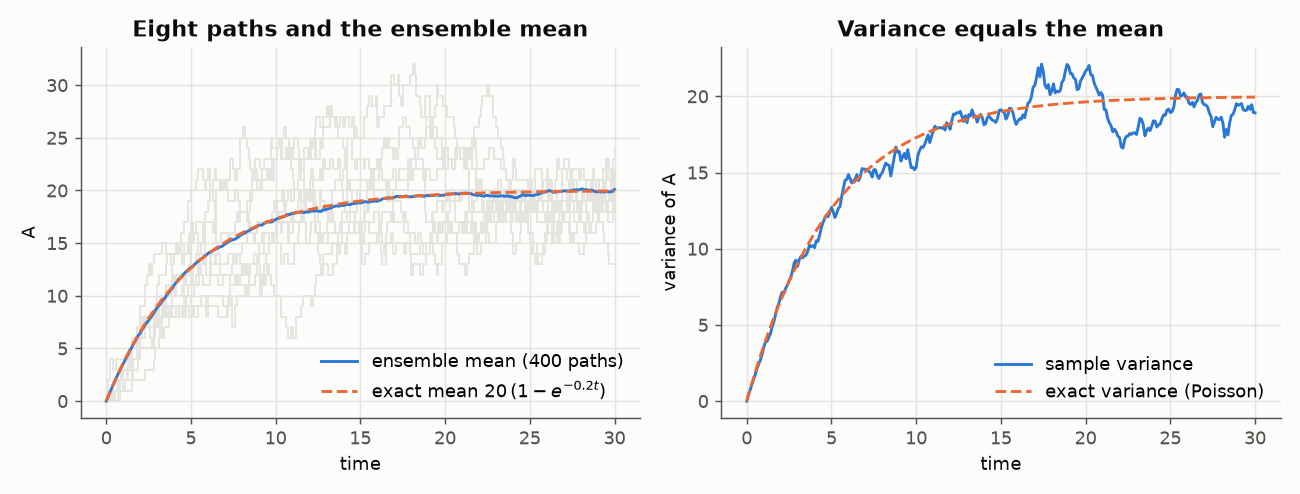
The immigration–death law is Poisson with mean 20 (1 - exp(-0.2 t)), so
the mean and the variance agree:
method="static_direct" is the exact method for a reaction network
(Gillespie’s direct method). Name it in every call: without method, a
slower exact method for models with changing species runs
(chapter 7).
The everyday arguments
| Argument | Meaning |
|---|---|
end | the time at which every replicate ends |
report_times | increasing times in [0, end] at which the state is recorded |
replicates | the number of trajectories; 1 by default |
seed | the root seed; 0 by default |
threads | 1 to 64 native threads; 1 by default |
keep_paths | how many replicates keep their whole series: a count, or "all" (chapter 4) |
method | a method name, or a dictionary with options (chapter 7) |
quantiles | probabilities for the quantile statistics (chapter 4) |
Report times are right-continuous: an event exactly at a report time is included. Statistics exist only at the report times, so choose them for the question. Python API lists every argument.
Seeds and threads
Every replicate draws from its own random stream, keyed by the root seed and the replicate’s index. A result therefore depends on the seed and the method, and not on the number of threads:
def run(seed, threads, replicates=64):
    return crn.ensemble(
        model, end=30.0, report_times=[0.0, 10.0, 20.0, 30.0],
        replicates=replicates, seed=seed, threads=threads, keep_paths="all",
        method="static_direct",
    ).simulate()


one, two, other = run(7, 1), run(7, 2), run(8, 2)
same = one.records.equals(two.records) and one.rule_events.equals(two.rule_events)
print("1 and 2 threads, same seed, identical records:", same)
print("identical statistics:", one.statistics["mean"].equals(two.statistics["mean"]))
print("identical paths:", one.paths.equals(two.paths))
print("seeds 7 and 8, identical events:", one.records["events"].equals(other.records["events"]))
# Replicate i always uses the same stream, whatever the size of the ensemble.
small = run(7, 1, replicates=8)
print("first 8 of 64 equal an 8-replicate run:",
      small.records["events"].equals(one.records["events"].head(8)))
1 and 2 threads, same seed, identical records: True
identical statistics: True
identical paths: True
seeds 7 and 8, identical events: False
first 8 of 64 equal an 8-replicate run: True
The same seed gives the same result again, on any machine and any number of threads. Replicate i is the same trajectory in a larger ensemble, so a run can be extended without changing what it already gave. Another seed gives other trajectories of the same law. Chapter 5 times the threads.
Check the termination
A run does not always complete. result.metadata["termination"] says how
the ensemble ended, and result.records["termination"] says it for every
replicate, with one of nine names:
| Termination | Meaning |
|---|---|
completed | the replicate reached end |
stopped | a stop condition ended it (chapter 6); this counts as complete |
event_limit, sampling_limit, instance_limit, wall_time_limit, output_limit | a budget was reached (next section) |
cancelled | the run was stopped from outside (last section) |
failed | a rate or a stop could not be evaluated; result.record_diagnostics says why |
Always check the termination before using statistics. If any replicate ended
on a budget, was canceled or failed, result.statistics is None: a
partial ensemble is never averaged as if it were complete.
Budgets
Every run has explicit limits. A replicate that reaches one stops there.
| Limit | Argument | Default | Termination | Code |
|---|---|---|---|---|
| events per replicate | max_events | 100,000,000 | event_limit | CRN-R040 |
| random numbers per replicate | max_sampling_steps | 16 × max_events | sampling_limit | CRN-R041 |
| live instances per replicate, for species with attributes (chapter 12) | max_instances | 100,000 | instance_limit | CRN-R042 |
| wall time of the whole run | wall_time_s | none | wall_time_limit | CRN-R043 |
| size of the result | max_output_bytes | 64 MiB | output_limit | CRN-R045 |
The event and sampling limits are a safety net against a model that runs
away, for example a rate with a sign error that makes the population
explode. They count work, not seconds, so a run stops at the same event on
every machine. The default lets a replicate run 10⁸ events, about ten
seconds of work at ten million events per second. max_sampling_steps follows max_events unless you give
it: an event draws one to about three random numbers, so 16 per event leaves
room, and a long run needs only max_events raised.
Here 50 events are too few for a run to time 30:
short = crn.ensemble(model, end=30.0, report_times=[0.0, 30.0], replicates=8,
                     seed=1, max_events=50, method="static_direct").simulate()
print(short.metadata["termination"], short.statistics)
print(short.records["termination"].value_counts()["event_limit"], "replicates hit the limit")
event_limit None
8 replicates hit the limit
A replicate that ends early is not an error, but simulate() warns with
crn.IncompleteEnsembleWarning, which Python prints on stderr, every time,
also for each batch of a loop. Here the warning is caught to show its
message:
import warnings

with warnings.catch_warnings(record=True) as caught:
    warnings.simplefilter("always")
    crn.ensemble(model, end=30.0, report_times=[0.0, 30.0], replicates=8, seed=1,
                 max_events=50, method="static_direct").simulate()
print(caught[0].category.__name__)
print(caught[0].message)
IncompleteEnsembleWarning
8 of 8 replicates ended early: 8 event_limit (raise max_events); result.statistics is None. result.records["termination"] gives the termination of every replicate. Pass strict=True to raise IncompleteEnsembleError instead.
The message counts the replicates per termination and names the argument
to raise for each. strict=True turns the warning into an error,
crn.IncompleteEnsembleError, whose result still holds the records:
try:
    crn.ensemble(model, end=30.0, report_times=[0.0, 30.0], replicates=8, seed=1,
                 max_events=50, method="static_direct", strict=True).simulate()
except crn.IncompleteEnsembleError as error:
    print(error)
    print(error.counts, len(error.result.records))
8 of 8 replicates ended early: 8 event_limit (raise max_events); result.statistics is None. result.records["termination"] gives the termination of every replicate.
{'event_limit': 8} 8
The remedy is a larger limit, not an average over cut-off replicates.
max_events=None removes the event and sampling limits: the request then
records the largest possible value, 2⁶⁴ − 1, so it still replays exactly.
Without a limit, a runaway model runs until it exhausts memory, so give such
a run a wall-time limit. It ends a run that takes longer than planned, at a
point that depends on the machine:
slow = crn.ensemble(model, end=1e7, report_times=[0.0, 1e7], replicates=4,
                    seed=1, threads=2, max_events=None, wall_time_s=0.2,
                    method="static_direct").simulate()
print(slow.metadata["termination"], slow.statistics)
print([d["code"] for d in slow.metadata["diagnostics"]])
print(sorted(set(slow.records["termination"])))
wall_time_limit None
['CRN-R050']
['wall_time_limit']
The warning CRN-R050 in the result says that the ensemble is incomplete
and its statistics are withheld. The records still account for every
replicate. A study that expects early ends, such as a parameter search that
gives up on extreme candidates, can silence the Python warning with
warnings.simplefilter("ignore", crn.IncompleteEnsembleWarning). A
canceled run (next section) and a replicate that a stop
condition ended are not reported.
Stopping a run
A long run can be stopped from outside by creating a file. The run ends with
the termination cancelled:
import pathlib

pathlib.Path("stop").touch()
long_run = crn.ensemble(model, end=1e6, report_times=[0.0, 1e6], replicates=8,
                        max_events=None, method="static_direct")
stopped = long_run.simulate(cancel_file="stop")
print(stopped.metadata["termination"], stopped.statistics)
cancelled None
Here the file exists before the run starts, so the run ends at once. On a
batch system, another job or a time limit creates the file. The engine looks
for it every 1,024 events. Ctrl-C cancels a running call in the same
way and raises KeyboardInterrupt within about 50 ms.
See also: Results, Speed, Troubleshooting.